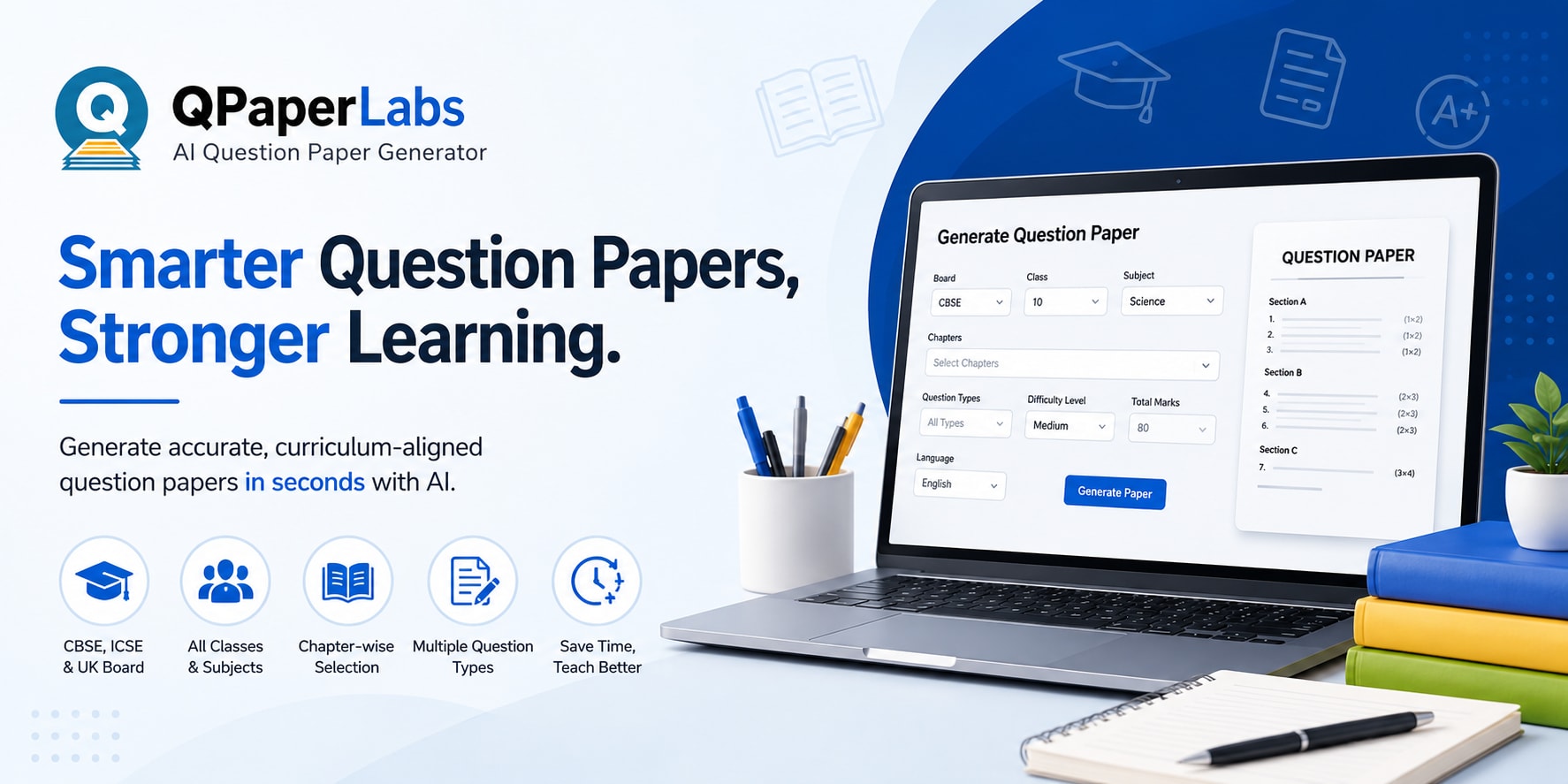
Creating a good question paper is an important part of teaching, but it can also be one of the most time-consuming tasks for teachers.
A teacher may need to review the syllabus, select chapters, decide the number and type of questions, maintain an appropriate difficulty level, avoid repeated questions, and make sure the final paper matches the requirements of the board and class.
For teachers handling multiple classes or subjects, preparing question papers manually can take several hours.
Artificial intelligence is changing this process. AI question paper generators can help teachers create structured question papers based on their selected board, class, subject, and chapters—allowing them to spend less time on repetitive preparation and more time focusing on teaching.
What Is an AI Question Paper Generator?
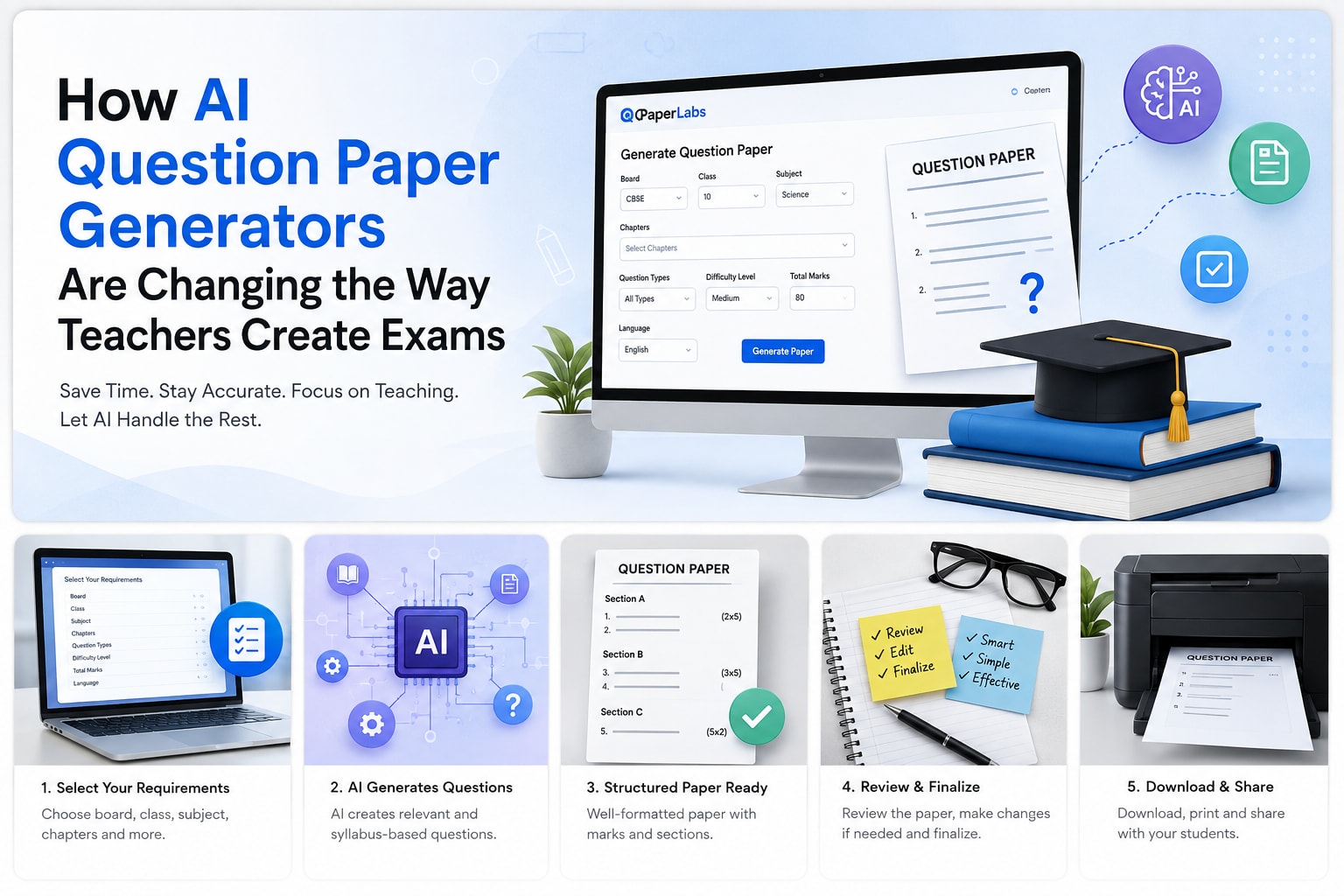
An AI question paper generator is a tool that uses artificial intelligence to create questions and organize them into a complete question paper based on specific academic requirements.
Instead of starting with a blank document, teachers can provide information such as:
Board
Class
Subject
Chapters
Question types
Number of questions
Difficulty level
Language
Marks and paper structure
The AI can then generate questions according to the selected requirements.
For example, a teacher preparing a Class 10 Science paper can select CBSE → Class 10 → Science → specific chapters, and generate questions based on those selections.
This can significantly reduce the amount of manual work involved in preparing an examination paper.
Why Creating Question Papers Manually Takes So Much Time
Question paper creation may appear simple, but a well-designed paper requires considerable planning.
Teachers often need to perform several tasks:
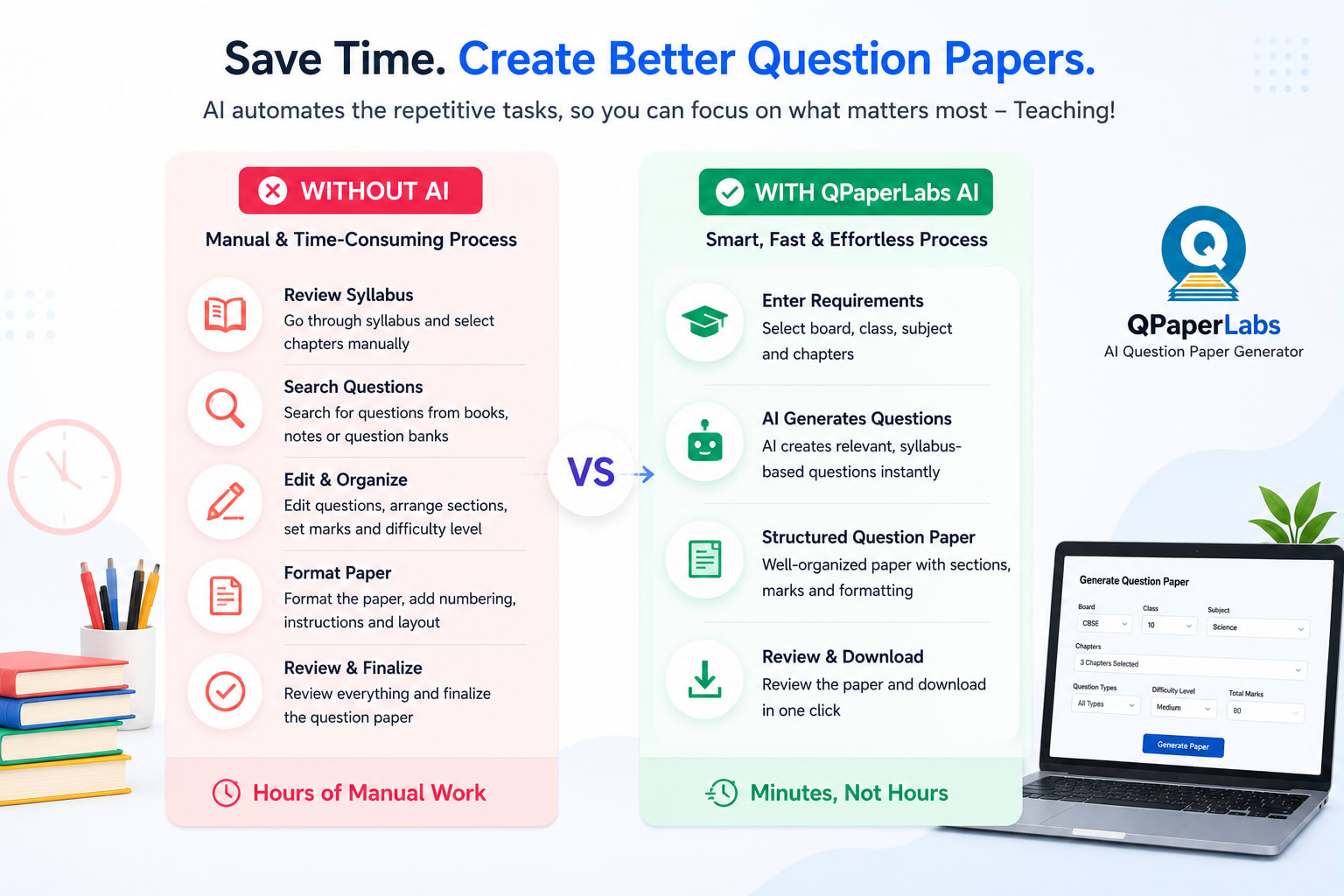
1. Review the Syllabus
Teachers first need to determine which chapters and topics should be included in the examination.
This becomes more complicated when a paper needs to cover multiple chapters while maintaining reasonable coverage across the syllabus.
2. Select Appropriate Questions
Questions should test different levels of understanding rather than simply asking students to memorize information.
A balanced paper may include questions that test:
Basic knowledge
Conceptual understanding
Application
Analysis
Problem-solving ability
3. Maintain the Right Difficulty Level
A question paper that is too easy may not properly evaluate students, while a paper that is unnecessarily difficult can create problems for students.
Teachers therefore need to balance easy, moderate, and challenging questions.
4. Avoid Repetition
When teachers prepare several papers manually, finding fresh questions can become difficult.
They may accidentally reuse similar questions or repeatedly test the same concept.
5. Format the Final Paper
After selecting questions, teachers still have to organize the paper, add sections, assign marks, number questions, and prepare the final document.
The entire process can take significant time.
How AI Can Make Question Paper Creation Easier
AI can assist teachers with many of these repetitive tasks.
Instead of manually searching through notes, textbooks, previous papers, and question banks, teachers can define their requirements and allow an AI system to generate questions accordingly.
A typical workflow can look like this:
Select Board → Select Class → Select Subject → Select Chapters → Configure Paper → Generate Question Paper
This approach allows teachers to start with their academic requirements rather than a blank document.
Generate Questions Based on Selected Chapters
One of the most useful features of an AI question paper generator is chapter-based question generation.
Teachers may not always want questions from the entire syllabus.
For example, a teacher may want a paper containing questions only from:
Mathematics – Quadratic Equations
Mathematics – Arithmetic Progressions
Mathematics – Triangles
Instead of manually searching for questions from each chapter, the teacher can select the required chapters and generate the paper.
This makes the process more targeted and useful for:
Class tests
Unit tests
Periodic assessments
Revision tests
Pre-board examinations
Practice papers
Homework assignments
Supporting Different Education Boards
Teachers work with different academic boards, and each board can have its own syllabus and academic structure.
An AI question paper platform designed for Indian educators can provide board-specific selection options such as:
CBSE
ICSE
UK Board (UBSE)
Teachers can select the board first and then choose the relevant class, subject, and chapters.
This creates a more organized workflow and reduces the need to manually search for curriculum information every time a question paper is prepared.
Creating Papers in Hindi and English
Language is another important consideration for Indian schools and teachers.
Depending on the classroom and school requirements, teachers may need question papers in English or Hindi.
An AI-powered system can help generate questions in the selected language, making it easier for teachers to prepare papers for different groups of students.
This can be particularly useful for schools and teachers who regularly prepare multiple versions of the same assessment.
AI Does More Than Just Generate Questions
An AI question paper generator should not simply produce a random collection of questions.
A useful system should consider the teacher's requirements and organize the generated content into a meaningful paper.
For example, a teacher may want:
Multiple-choice questions
Very short-answer questions
Short-answer questions
Long-answer questions
Application-based questions
Numerical problems
Conceptual questions
The teacher can then create a paper using a combination of different question formats.
This provides greater flexibility than simply generating a list of questions.
AI Can Help Teachers Save Preparation Time
Time is one of the biggest advantages of using AI for question paper creation.
Consider a teacher who normally spends one or two hours preparing a test.
The process may include:
Syllabus review → Question selection → Question editing → Marks allocation → Formatting → Final review
An AI-powered question paper generator can automate much of the repetitive preparation process.
The teacher still reviews the final paper, but instead of creating everything from scratch, they begin with an AI-generated draft.
This changes the role of technology from replacing the teacher to assisting the teacher.
Teachers Should Still Review AI-Generated Questions
AI can make question paper creation faster, but teachers should always review the generated paper before giving it to students.
This is important because an AI-generated question may occasionally:
Contain an inaccurate statement
Have ambiguous wording
Require a concept that was not covered
Have an unsuitable difficulty level
Need correction or refinement
Not match the teacher's intended assessment pattern
The teacher remains the final decision-maker.
A good workflow is therefore:
Generate → Review → Edit → Finalize → Share
This combines the speed of AI with the subject knowledge and judgment of the teacher.
How QPaperLabs Helps Teachers Create Question Papers
QPaperLabs is designed specifically around the question-paper creation workflow for educators.
Instead of manually creating every paper from scratch, teachers can select their academic requirements and generate a question paper using AI.
The workflow is simple:
Step 1: Select the Board
Choose the required board, such as CBSE, ICSE, or UK Board.
Step 2: Select the Class
Choose the class for which the paper is being prepared.
Step 3: Select the Subject
Choose the relevant subject.
Step 4: Select Chapters
Choose one or more chapters that should be included in the paper.
Step 5: Generate the Paper
The system uses the selected information to generate questions and organize them into a question paper.
This can help teachers prepare assessments more efficiently without spending hours building every paper manually.
Useful for More Than Just Final Examinations
Question paper generation is not limited to annual or board examinations.
Teachers can use generated papers for many types of assessments, including:
Class Tests
Create short tests based on recently completed chapters.
Unit Tests
Generate assessments covering a specific unit or group of chapters.
Revision Papers
Create practice papers before examinations.
Mock Tests
Generate additional papers for students preparing for important examinations.
Homework
Create chapter-specific questions for regular practice.
School Examinations
Prepare structured papers for internal assessments and examinations.
The Future of AI in Education
AI is increasingly becoming a practical assistant for teachers.
Its value is not necessarily in replacing traditional teaching methods. Instead, AI can reduce repetitive administrative and preparation work so teachers can dedicate more time to students.
Question paper generation is one example of this shift.
A teacher's expertise is still essential for deciding:
What students should learn
What concepts are important
How students should be assessed
Whether a question is appropriate
Whether the final paper is suitable for the class
AI can assist with the preparation, while the teacher remains in control of the final outcome.
Final Thoughts
Preparing a quality question paper requires more than simply collecting questions. Teachers need to consider the syllabus, chapters, question types, difficulty, marks, and overall structure of the examination.
AI question paper generators can simplify this process by helping teachers generate questions based on their specific requirements.
For educators working with CBSE, ICSE, and UK Board, tools such as QPaperLabs can make question-paper preparation faster and more organized.
The goal is simple: less time spent creating papers manually and more time available for teaching, revision, and supporting students.
If you are a teacher looking for a faster way to create chapter-based question papers, you can explore QPaperLabs and generate your next paper using AI.