The CBSE Class 10 Maths blueprint for 2026-27 has 80 theory marks spread across seven units. Algebra carries the most at 20 marks, followed by Geometry (15), Trigonometry (12), Statistics and Probability (11), Mensuration (10), and Number Systems and Coordinate Geometry (6 each). The paper has 38 questions in five sections and lasts 3 hours.
Knowing the blueprint helps teachers set pre-boards that match the real exam, and helps students spend revision time where the marks are. This guide covers the unit-wise marks, the section pattern, how Maths Standard and Basic differ, and a ready-to-use 80-mark blueprint.
What is the CBSE Class 10 Maths marks distribution for 2026-27?
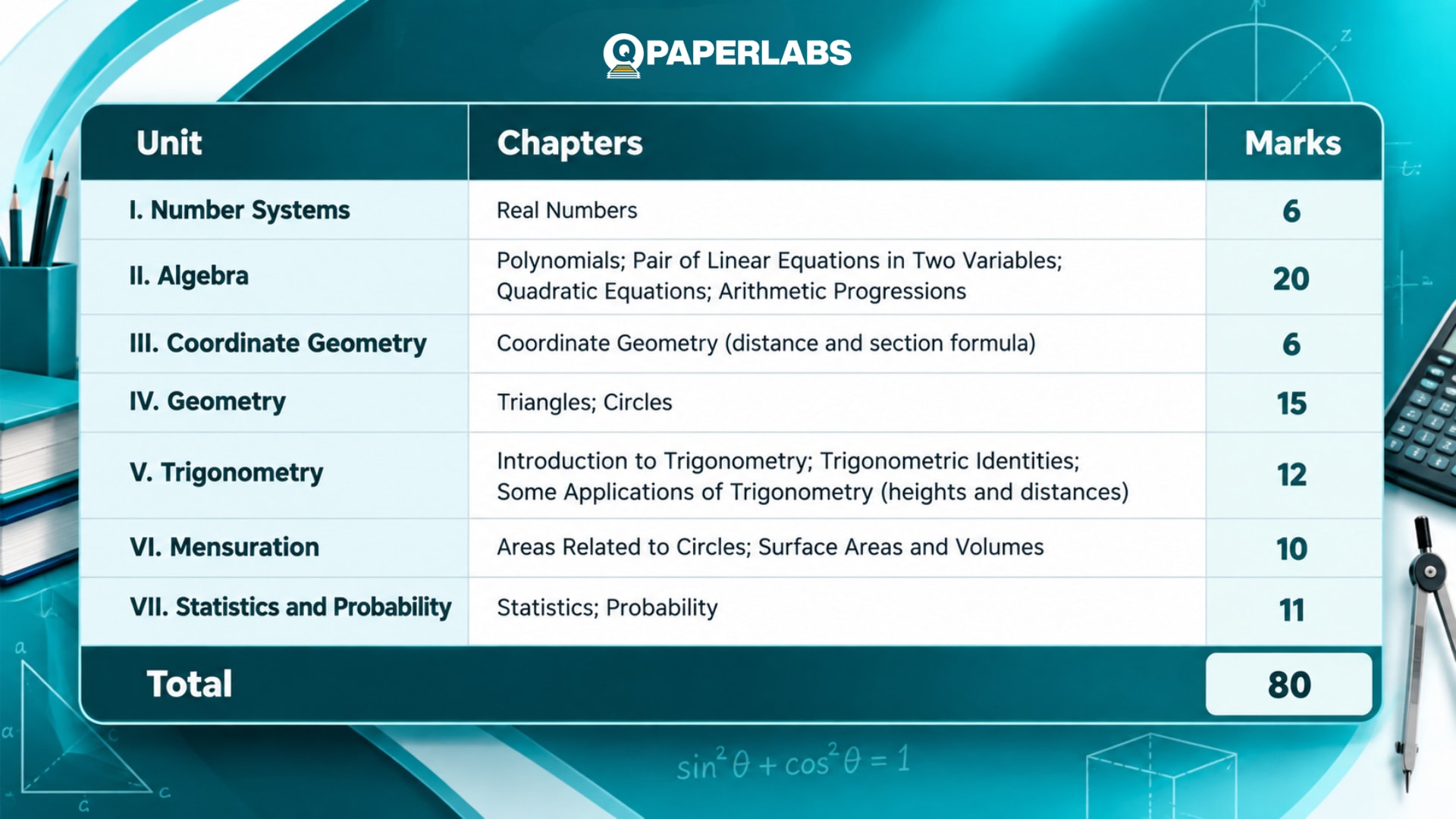
Class 10 Maths carries 100 marks: an 80-mark theory paper and 20 marks of internal assessment. The theory marks are divided by unit:
Unit | Chapters | Marks |
|---|---|---|
I. Number Systems | Real Numbers | 6 |
II. Algebra | Polynomials; Pair of Linear Equations in Two Variables; Quadratic Equations; Arithmetic Progressions | 20 |
III. Coordinate Geometry | Coordinate Geometry (distance and section formula) | 6 |
IV. Geometry | Triangles; Circles | 15 |
V. Trigonometry | Introduction to Trigonometry; Trigonometric Identities; Some Applications of Trigonometry (heights and distances) | 12 |
VI. Mensuration | Areas Related to Circles; Surface Areas and Volumes | 10 |
VII. Statistics and Probability | Statistics; Probability | 11 |
Total | 80 |
Algebra and Geometry together carry 35 marks, almost half the paper.
What is the section-wise pattern of the Class 10 Maths paper?
The 2026-27 Maths paper has 38 compulsory questions in five sections. Maths Standard and Maths Basic follow the same structure.
Section | Question type | Questions | Marks each | Total marks | Internal choice |
|---|---|---|---|---|---|
A | 18 MCQs + 2 assertion-reason | 20 | 1 | 20 | None |
B | Very short answer | 5 | 2 | 10 | In 2 questions |
C | Short answer | 6 | 3 | 18 | In 2 questions |
D | Long answer | 4 | 5 | 20 | In 2 questions |
E | Case study (sub-parts of 1 + 1 + 2 marks) | 3 | 4 | 12 | In the 2-mark sub-part |
Total | 38 | 80 |
For the full pattern of every subject, see the CBSE question paper pattern 2026-27.
How is Maths Standard different from Maths Basic?
Both papers have the same syllabus, the same 38 questions and the same 80 marks. The difference is the type of thinking each one tests:
Question typology | Maths Standard | Maths Basic |
|---|---|---|
Remembering and understanding (concept-based) | 43 marks (54%) | 60 marks (75%) |
Applying | 19 marks (24%) | 12 marks (15%) |
Analysing, evaluating and creating | 18 marks (22%) | 8 marks (10%) |
Total | 80 | 80 |
So a Basic paper has more direct questions, while a Standard paper has more multi-step and reasoning questions. Students who plan to take Maths in Class 11 should choose Standard.
Sample blueprint for a Class 10 Maths pre-board (80 marks)
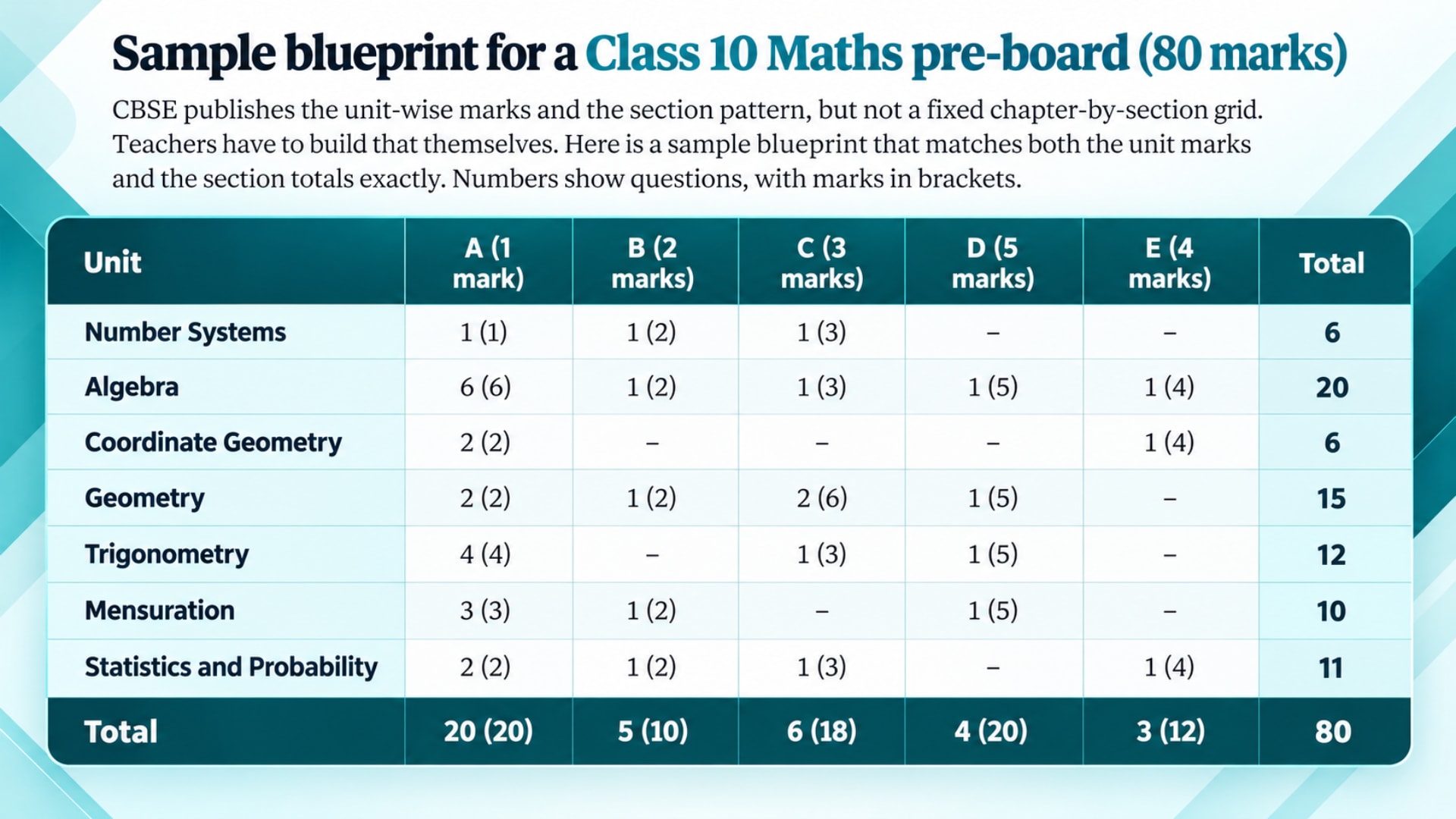
CBSE publishes the unit-wise marks and the section pattern, but not a fixed chapter-by-section grid. Teachers have to build that themselves. Here is a sample blueprint that matches both the unit marks and the section totals exactly. Numbers show questions, with marks in brackets.
Unit | A (1 mark) | B (2 marks) | C (3 marks) | D (5 marks) | E (4 marks) | Total |
|---|---|---|---|---|---|---|
Number Systems | 1 (1) | 1 (2) | 1 (3) | – | – | 6 |
Algebra | 6 (6) | 1 (2) | 1 (3) | 1 (5) | 1 (4) | 20 |
Coordinate Geometry | 2 (2) | – | – | – | 1 (4) | 6 |
Geometry | 2 (2) | 1 (2) | 2 (6) | 1 (5) | – | 15 |
Trigonometry | 4 (4) | – | 1 (3) | 1 (5) | – | 12 |
Mensuration | 3 (3) | 1 (2) | – | 1 (5) | – | 10 |
Statistics and Probability | 2 (2) | 1 (2) | 1 (3) | – | 1 (4) | 11 |
Total | 20 (20) | 5 (10) | 6 (18) | 4 (20) | 3 (12) | 80 |
Two of the 20 Section A questions should be assertion-reason. Rotate which units get the long answers and case studies between pre-boards, so students practise every unit in every format.
How to make a smaller Class 10 Maths test
For a 40-mark half-yearly or unit test, keep the same balance but halve the paper. A common plan is 10 one-mark, 5 two-mark, 4 three-mark and 2 four-mark questions, which adds up to 40 marks in about 90 minutes. Spread marks across only the chapters taught so far, giving more to the longer chapters.
For the full step-by-step method, read how to make a question paper.
How to build this blueprint in QPaper Labs
You can set up the blueprint above once and generate a fresh paper from it each time:
Open Create Paper and pick CBSE, Class 10, Mathematics.
Select the chapters, set 80 marks and 180 minutes, and choose the exam type.
Add sections A to E with the question counts and marks from the table.
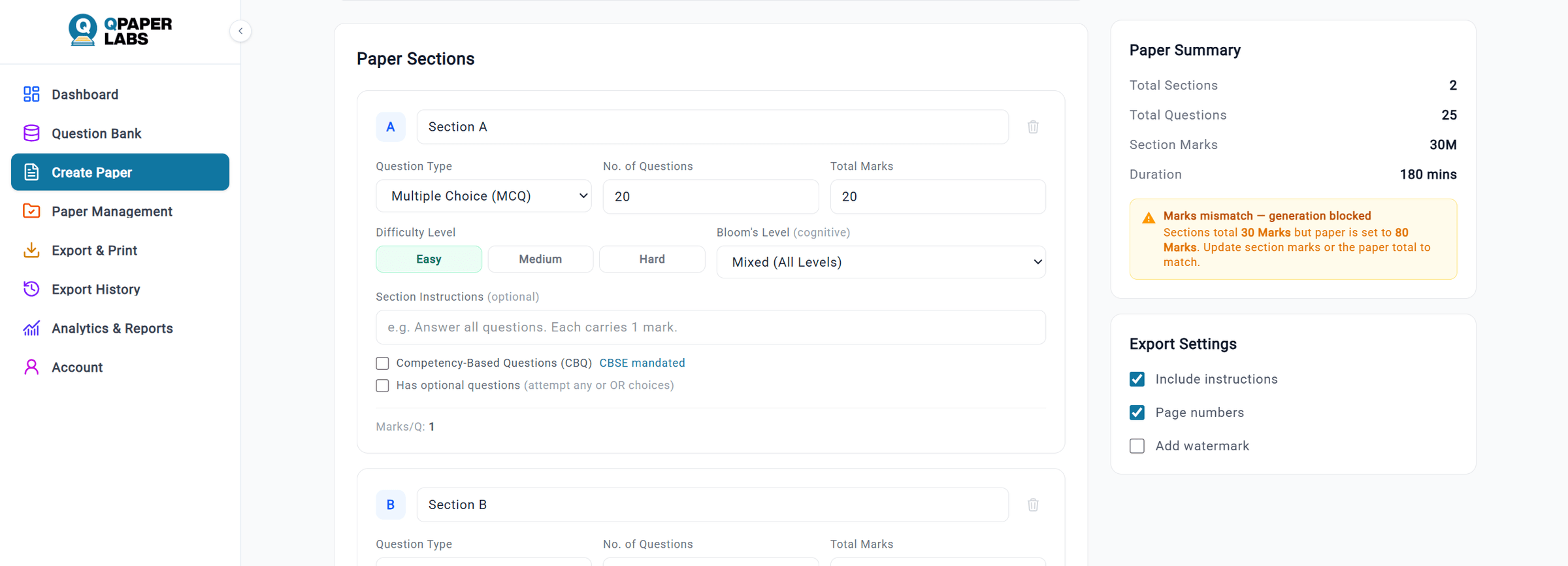
Generate questions with AI, or pick them yourself from the question bank. The paper summary blocks generation if the marks do not add up to 80.
Review every question, then export a branded PDF with your school logo.
See the full process in how to create a CBSE question paper with AI, or browse ready Maths questions by chapter in the Question Explorer.
Tips for teachers setting a Maths paper
Show steps in the marking scheme. Maths marks are given step by step, so split every 3- and 5-mark answer into clear steps.
Mix contexts in case studies. Use real situations such as a park layout, a savings plan or a survey, not only textbook problems.
No calculators. Keep numbers manageable and say “take π = 22/7” where needed.
Check figures to scale. Geometry and Mensuration diagrams must be clear and correctly labelled.
Balance Standard and Basic. If your school runs both, use the same blueprint but change the depth of questions, not the structure.
Frequently asked questions
Which unit has the highest weightage in CBSE Class 10 Maths?
Algebra, with 20 of the 80 theory marks. It covers Polynomials, Pair of Linear Equations, Quadratic Equations and Arithmetic Progressions.
How many questions are there in the Class 10 Maths paper 2026-27?
38 compulsory questions in five sections (A to E) for 80 marks. The exam is 3 hours long, and internal choice is given in some questions.
Is the blueprint the same for Maths Standard and Basic?
Yes, the units, marks and sections are the same. Basic has more direct, concept-based questions (75% of marks), while Standard has more application and reasoning questions.
What is the internal assessment in Class 10 Maths?
20 marks: periodic tests and multiple assessment (10), portfolio (5) and lab practical activities (5).
Does CBSE give a chapter-wise blueprint for Maths?
CBSE gives unit-wise marks and the section pattern. Teachers build the chapter-by-section grid themselves, like the sample blueprint in this guide.
Set your next Maths pre-board in minutes
Save the blueprint once and generate a fresh, balanced Maths paper whenever you need one. Try QPaper Labs free for 7 days.