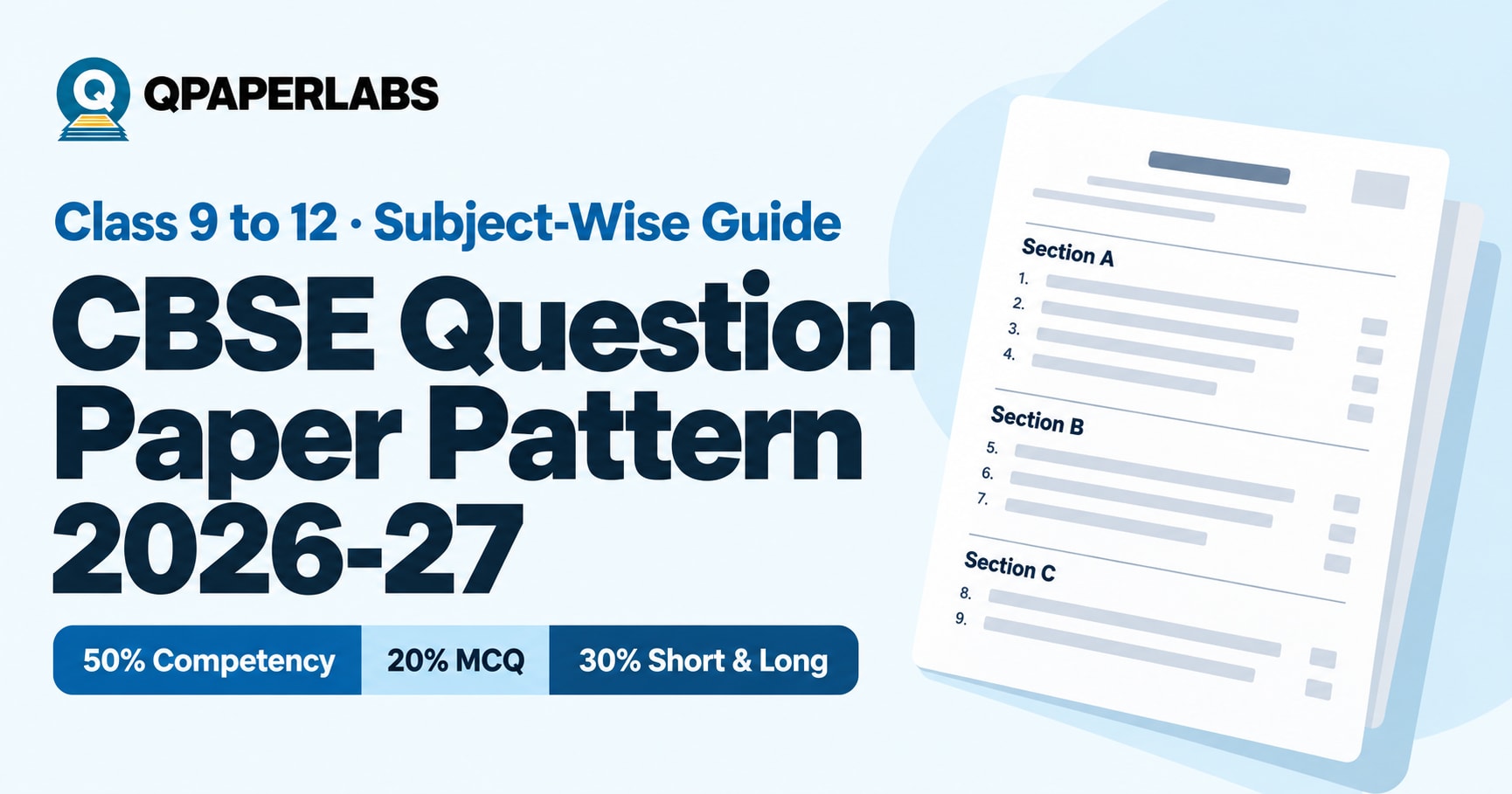
The CBSE question paper pattern for 2026-27 has not changed from last year. Every theory paper for Classes 9 to 12 follows the same split: 50% competency-based questions, 20% MCQs and 30% short and long answer questions. Class 10 main subjects carry 80 theory marks and Class 12 science subjects carry 70.
CBSE released the 2026-27 sample question papers on 21 September 2026, and each one states there is no change in the question paper design or assessment pattern for this session. This guide puts the full pattern in one place: the question typology, section-wise marks for each major subject, and how the two board exams for Class 10 work.
Has the CBSE question paper pattern changed for 2026-27?
No. The 2026-27 pattern is the same as 2025-26. The 50-20-30 question typology introduced in 2024-25 continues, theory papers remain 3 hours long, and internal choice is still given in selected questions. The biggest change for Class 10 is not the paper design but the number of attempts: students now get two board exams.
What is the 50-20-30 question split?
Every CBSE theory paper is built from three question types:
Question type | Share of marks | What it includes |
|---|---|---|
Competency-based questions | 50% | Case-based, source-based and application questions, including competency-focused MCQs |
Select-response questions | 20% | Direct MCQs and assertion-reason questions |
Constructed-response questions | 30% | Short answer and long answer questions |
Competency-based questions test whether students can apply a concept to a new situation, a passage, a graph or a real-life case, rather than recall a definition.
CBSE Class 10 exam pattern 2026-27 (subject-wise)
Main Class 10 subjects carry 100 marks: an 80-mark theory paper set by CBSE and 20 marks of internal assessment by the school. Each theory paper is 3 hours long.
Subject | Questions | Theory marks | Sections |
|---|---|---|---|
Science | 39 | 80 | 3 (Biology, Chemistry, Physics) |
Mathematics (Standard and Basic) | 38 | 80 | 5 (A to E) |
Social Science | 38 | 80 | 4 (History, Geography, Political Science, Economics) |
English Language and Literature | 11 | 80 | 3 (Reading, Writing and Grammar, Literature) |
Class 10 Science. The 39 questions are grouped by subject: Biology carries 30 marks, Chemistry 25 and Physics 25. Across the paper there are 20 one-mark questions (MCQ and assertion-reason), 6 two-mark, 7 three-mark, 3 four-mark case or experiment-based and 3 five-mark questions.
Class 10 Mathematics. Standard and Basic papers share the same design; only the difficulty differs.
Section | Question type | Questions | Marks each | Total |
|---|---|---|---|---|
A | 18 MCQs + 2 assertion-reason | 20 | 1 | 20 |
B | Very short answer | 5 | 2 | 10 |
C | Short answer | 6 | 3 | 18 |
D | Long answer | 4 | 5 | 20 |
E | Case study | 3 | 4 | 12 |
Total | 38 | 80 |
Class 10 Social Science. Each of the four sections carries exactly 20 marks. The paper has 20 MCQs, 4 very short answers (2 marks), 5 short answers (3 marks), 4 long answers (5 marks), 3 case-based questions (4 marks) and 5 marks of map work (2 in History, 3 in Geography).
Class 10 English Language and Literature. Reading carries 20 marks, Writing and Grammar 20, and Literature 40.
CBSE Class 12 exam pattern 2026-27 (subject-wise)
Physics, Chemistry and Biology now share one identical design: 33 compulsory questions for 70 theory marks, with 30 marks for practicals. Mathematics has 38 questions for 80 theory marks.
Section | Physics, Chemistry, Biology | Mathematics |
|---|---|---|
A | 16 × 1 mark (MCQ + assertion-reason) | 20 × 1 mark (18 MCQ + 2 assertion-reason) |
B | 5 × 2 marks | 5 × 2 marks |
C | 7 × 3 marks | 6 × 3 marks |
D | 2 × 4 marks (case-based) | 4 × 5 marks |
E | 3 × 5 marks | 3 × 4 marks (case study) |
Total | 33 questions, 70 marks | 38 questions, 80 marks |
Note that the order flips: in the science papers the case-based questions are in Section D and long answers in Section E, while Maths puts long answers in D and case studies in E.
What about Class 9 and Class 11?
Class 9 and 11 annual exams are set by schools, not by CBSE. Most schools mirror the board design so students practise the real format early: Class 9 papers follow the Class 10 structure, and Class 11 papers follow the Class 12 structure, with the same 50-20-30 split.
How do the two Class 10 board exams work?
Class 10 follows a two-exam system that began in 2025-26:
Phase 1 is compulsory for every student and covers all subjects.
Phase 2 is optional and can be used to improve marks in up to three subjects among Science, Mathematics, Social Science and languages.
Internal assessment is done once and counts for both attempts.
Same pattern: both exams use the same question paper design, so one set of practice covers both.
Phase 1 is expected from February 2027 and Phase 2 around May 2027. Confirm the dates on the official CBSE date sheet.
How should teachers set papers in this pattern?
For pre-boards and half-yearly exams, use the board design exactly so students get used to it. For unit tests, keep the same 50-20-30 balance but shrink the paper: a 40-mark unit test can still have half its marks from case-based and application questions.
The fastest way to build a pattern-correct paper is to create a CBSE question paper with AI. Watch how it works in under a minute:
In QPaper Labs, the blueprint builder sets sections, marks and question counts, and the paper summary blocks generation if the marks do not match the total. You can also browse ready questions by class and chapter in the Question Explorer. It is built for teachers setting their own tests and for schools that want one standard format across departments.
Frequently asked questions
Is there any change in the CBSE question paper pattern for 2026-27?
No. CBSE’s 2026-27 sample papers state that there is no change in the question paper design or assessment pattern. The 50% competency, 20% MCQ and 30% short and long answer split continues.
How many marks are competency-based in the CBSE 2026-27 exam?
Half. In an 80-mark Class 10 paper, about 40 marks come from competency-based questions such as case-based, source-based and application questions.
How many questions are in the CBSE Class 10 Science paper 2026-27?
39 questions for 80 marks, grouped into Biology (30 marks), Chemistry (25) and Physics (25). The exam is 3 hours long.
How many questions are in the CBSE Class 12 Physics paper?
33 compulsory questions for 70 theory marks, in five sections. Chemistry and Biology follow the same design. Practicals carry the remaining 30 marks.
Do Class 10 students get two board exams in 2027?
Yes. The first exam is compulsory. The second is optional and lets students improve their marks in up to three main subjects. The better score is kept.
Where can I download the official CBSE sample papers?
On cbseacademic.nic.in, under Sample Question Papers for 2026-27. Each subject has a question paper and a matching marking scheme.
Build your next paper in the 2026-27 pattern
Set the pattern once and let the marks, sections and question mix follow it automatically. Try QPaper Labs free for 7 days.